
Kia Sorento Key Specs
- 1598 - 2151 cc
Engine - 15.79-17.7 kmpl
Mileage - 177 - 190 bhp
Power - Hybrid/ Diesel
Fuel - 265 - 442 Nm
Max Torque - AWD
Drive Train

Based on your credit profile
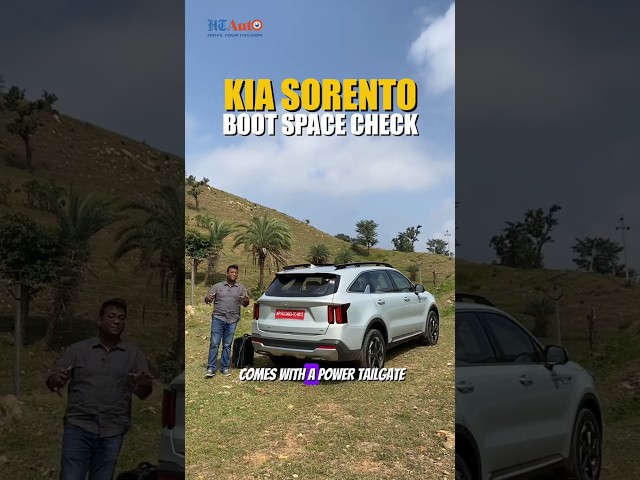
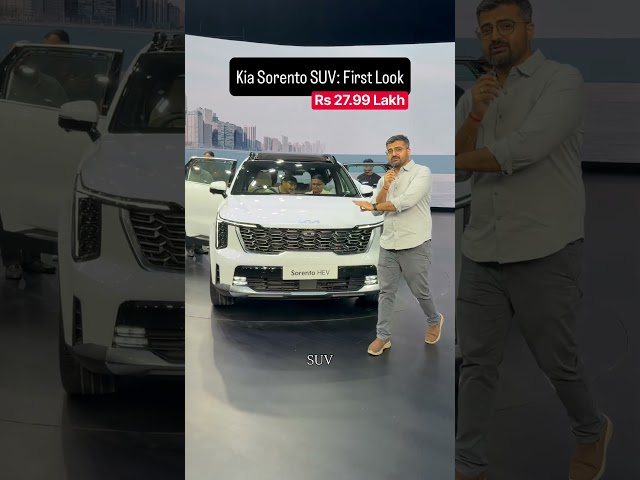
Kia Sorento impresses with a refined hybrid, comfortable second row, premium cabin and composed handling, though its third row and ride have compromises.Read Full Story
Kia India launches the Sorento SUV with hybrid technology, featuring premium styling, spacious interiors, and extensive safety features.Read Full Story
Kia launches the Sorento in India, featuring three-row seating, hybrid and diesel engines, and multiple drivetrain options.Read Full Story
Kia India launches the Sorento SUV with hybrid options, featuring advanced tech and safety, priced from ₹27.99 lakh.Read Full Story
The Kia Sorento has a fairly straightforward brief. It needs to offer the space and practicality expected of a large family SUV, deliver the sort of comfort that makes long journeys easier, and feel premium enough to justify its position in the market. With prices starting at ₹28 lakh and going up to ₹40 lakh, it also finds itself in a segment where buyers have plenty of established alternatives to consider.
On paper, the Sorento seems to have most of the right ingredients. There is a choice of diesel and hybrid powertrains, six- and seven-seat configurations, and a cabin that looks familiar to anyone who has spent time in a modern Kia. But a large SUV can get away with only so much on the strength of its features and road presence. What matters is how well everything comes together when you actually spend time with it.
At nearly five metres long, the Sorento is a substantial SUV, and Kia has done a fairly good job of making its size work in its favour. It has a commanding road presence, but it doesn't resort to excessive cladding or exaggerated styling elements to look imposing.
The design follows Kia's latest styling language, with a boxy silhouette that gives the SUV a suitably upmarket appearance. There are enough curves and detailing to break up the otherwise upright proportions, while the overall design remains clean and fairly restrained.
I particularly like the fact that Kia hasn't tried too hard to make the Sorento look like an off-road machine. This is an SUV that appears more comfortable outside a premium hotel or on a long highway drive than crawling over rocks. That isn't necessarily a bad thing. Its intended role is that of a family SUV, and the design reflects that.
The proportions are well judged, too. Despite its considerable length, the Sorento doesn't look awkward or overly stretched. It has the presence expected of a vehicle in this category without trying to make a statement at every opportunity.
Step inside the Sorento and the dashboard layout will feel familiar if you've driven other modern Kia models. The overall design isn't radically different, but the materials and finish help give the cabin a suitably premium feel.
The upper section of the dashboard features soft-touch materials, which extend to parts of the door pads. The grab handles on the doors also get soft-touch surfaces, while brushed aluminium-style trim adds a welcome bit of contrast. The lower sections of the dashboard and door pads use harder plastics, but the overall quality feels decent.
The dashboard is dominated by two 12.3-inch screens, one for the digital instrument cluster and the other for the infotainment system. Both use interfaces that will be familiar to existing Kia owners. The instrument cluster is crisp and easy to read, with customisable displays, while the infotainment screen has large icons and a straightforward layout.
What I appreciate is the way Kia has integrated both screens into a single housing. It gives the dashboard a cleaner appearance than having two separate displays seemingly stuck onto it as an afterthought.
The climate controls, however, are touch-sensitive. I'm still not entirely convinced that this is the best solution for functions that you regularly use while driving. Physical buttons and knobs are generally easier to operate without taking your eyes off the road. Kia has at least made the displays large and reasonably easy to read, so the arrangement isn't particularly difficult to get used to.
Storage and everyday practicality have also received some attention. The door pockets can accommodate full-sized water bottles, while the centre console has a cubby for a smartphone, two USB Type-C charging ports and a pair of cup holders. There's additional storage underneath the armrest, complete with a removable tray.
Nothing here feels particularly revolutionary, but the Sorento gets the basics right. The cabin is easy to understand, the controls aren't needlessly complicated, and there's enough storage space to make everyday use convenient.
A large SUV needs to do more than look imposing. If it's expected to carry a family over long distances, the second row needs to be a comfortable place to spend time. This is where the Sorento makes a fairly convincing case for itself.
The six-seat version gets individual captain seats in the second row, and these are nicely contoured. They come with individual armrests and offer a comfortable seating position. With the front seat adjusted to my driving position, there was plenty of knee room and a decent amount of headroom as well. For reference, I'm 5 feet 8 inches tall.
The feature list for rear passengers is fairly comprehensive. There are dedicated AC vents, USB Type-C charging ports behind both front seats, seat-back pockets and additional storage in the door pads. Passengers also get dedicated cup holders, rear sunshades and ventilated seats.
The availability of a 12V socket and a 220V power outlet is another useful touch, particularly for those who carry electronic devices on longer journeys.
The second row is easily one of the more convincing parts of the Sorento's package. The captain seats make the cabin feel more lounge-like, and the available amenities should keep passengers comfortable over extended journeys.
Buyers who need to carry more people can also opt for the seven-seat configuration. That brings us to the third row, which is a rather important consideration in an SUV of this size.
Accessing the third row involves pressing a button that allows the second-row seat to tumble forward. This opens up a passage to the rearmost seats, although climbing in still requires a little effort.
Once seated, the space isn't unreasonable for a third row. There's a usable amount of legroom, provided the second-row passengers are willing to move their seats forward a little. However, the seating position is quite knees-up, which makes it less suitable for adults on longer journeys.
The third row is better suited to children or shorter trips. At least Kia hasn't completely neglected the passengers back here. They get dedicated AC controls, cup holders, a place to keep a smartphone, USB Type-C charging ports and a 12V socket.
Boot space is naturally affected by the three-row layout. With all three rows in use, the Sorento offers 179 litres of luggage capacity, which is enough for smaller bags but won't accommodate much in the way of bulky luggage.
Fold the third row down, however, and capacity increases to more than 800 litres. The absence of a significant loading lip also makes it easier to load longer or heavier items.
As with most three-row SUVs, buyers will need to decide how often they expect to use all seven seats. The Sorento works best when the third row is treated as additional seating rather than a permanent home for adult passengers.
Kia offers the Sorento with diesel and hybrid powertrains, giving buyers two different approaches to getting around in a large SUV.
The diesel version uses a 2.2-litre turbocharged engine producing around 142 hp and 442 Nm of torque, paired with an eight-speed dual-clutch transmission. The hybrid, meanwhile, combines a 1.6-litre turbocharged petrol engine producing around 137 hp with an electric motor rated at approximately 47 hp. It uses a six-speed automatic transmission, and the version driven here also gets all-wheel drive.
The hybrid powertrain is arguably one of the more interesting aspects of the Sorento. What stands out isn't just the electric assistance, but how smoothly the system operates.
The transition between the petrol engine and electric motor is well managed, with very little noticeable interruption as the drivetrain switches between the two. The overall experience is refined, and the hybrid system feels well integrated rather than like an additional layer of technology that the driver has to work around.
The electric assistance also helps the Sorento get moving with a fair amount of urgency. There is a noticeable initial shove when you get on the throttle, and the SUV gathers speed without requiring much effort.
Of course, this isn't a performance SUV, and the powertrain doesn't pretend to be one. The focus is on smooth, effortless progress rather than sharp, aggressive responses. The gearbox reacts quickly enough when you ask for more power, and overtaking manoeuvres feel relatively straightforward. Even on inclines, the engine has enough in reserve to keep the SUV moving without feeling particularly strained.
There are three driving modes: Eco, Sport and Smart. The all-wheel-drive version also gets Snow, Mud and Sand terrain modes.
However, there is one aspect of the hybrid powertrain that could be better. Push the engine hard, and it becomes noticeably vocal, with more noise entering the cabin than you'd expect given the performance on offer. The Sorento feels refined when driven normally, but the engine's soundtrack becomes less appealing when you ask for sustained acceleration.
It isn't a deal-breaker, particularly because the rest of the drivetrain is so smooth. Still, a little more refinement under hard acceleration would have made the experience more complete.
Large family SUVs aren't usually the first vehicles that come to mind when talking about driving enjoyment. The Sorento, however, has a suspension setup that gives it a more engaging character than you might expect.
Kia has tuned the suspension on the firmer side. This means sharp bumps and potholes can make their presence felt inside the cabin, particularly when the road surface deteriorates. On rough sections, the suspension occasionally lets harder impacts through.
That said, the ride quality is generally decent. The Sorento doesn't feel unsettled every time the road gets rough, and the suspension manages to keep things reasonably composed over varying surfaces. It simply isn't as forgiving over sharp imperfections as some buyers might expect from a large family SUV.
The upside of that firmer setup becomes apparent when the road starts to bend. The Sorento feels surprisingly willing to change direction, and body roll is well controlled for a vehicle of this size. It doesn't suddenly transform into a sports SUV, but it feels more composed through corners than its dimensions might suggest.
If you enjoy driving rather than simply being transported from one destination to another, there's something to appreciate here.
The brakes are less impressive. They offer predictable, progressive stopping power, but the pedal could do with a little more bite and feedback. For everyday driving, they get the job done, although stronger initial bite would inspire more confidence during emergency braking.
One area where the Sorento does a particularly good job is cabin insulation. During highway driving at triple-digit speeds, wind noise remained well controlled. Road noise was also kept in check across different surfaces, including tarmac and cobbled roads.
This adds considerably to the premium feel of the SUV. The Sorento feels like a vehicle designed to cover long distances without constantly reminding occupants about the surface beneath its wheels or the speed at which they're travelling.
Combined with the smooth hybrid drivetrain and comfortable second-row seats, the quiet cabin makes a strong case for the Sorento as a long-distance family vehicle.
The Kia Sorento gets several important things right. It has the road presence expected of a large premium SUV, a well-finished cabin, a genuinely comfortable second row and a hybrid powertrain that delivers smooth, effortless performance in everyday driving.
It also has a few shortcomings. The third row is best reserved for children or shorter journeys; the suspension can feel firm over sharp bumps, and the hybrid engine becomes noisy when pushed hard. The touch-sensitive climate controls and the lack of stronger brake bite are smaller areas where Kia could have done better.
None of these issues fundamentally undermine the Sorento's character, though. Its strengths become apparent when you look at it as a family SUV rather than a vehicle that needs to excel at just one thing.
At ₹28 lakh to ₹40 lakh, it enters a competitive part of the market, and the choice between the diesel and hybrid powertrains will depend on what buyers prioritise. The hybrid, in particular, makes a strong impression with its refinement and smooth delivery of power.
The Sorento isn't trying to be the most rugged SUV on sale, nor is it chasing outright performance. Instead, it offers a combination of space, comfort, features and everyday drivability, with a little more enthusiasm in the corners than you might expect.
For buyers looking for a premium six- or seven-seat SUV, that makes the Kia Sorento worth considering. It may not get everything right, but it does enough to make a convincing case for itself.
| 1 & above | |
| 2 & above | |
| 3 & above | |
| 4 & above | |
| 5 rating |
| Rear AC Vents | Yes |
| Max Power | 177-190 bhp |
| Body Type | SUV |
| Airbags | 10 Airbags |
| Max Torque | 265-442 Nm |
| Keyless Entry | Yes |
| Mileage | 15.79 kmpl |
| Transmission | Automatic |
| Engine | 1598-2151 cc |
| Sunroof | Yes |
| Fuel Type | Hybrid (Electric + Petrol), Diesel |
Popular Kia Cars
Copyright © HT Media Limited All rights reserved.