

Honda Elevate Key Specs
- Engine1498 cc
- Mileage15.31-16.61 kmpl
- Power119 bhp
- FuelPetrol
- Boot Space458 litres
- Max Torque145 Nm
- Drive TrainFWD

 13 Oct 202610 Oct 202610 Oct 20269 Oct 2026

| CAR | IMAGE | EX-SHOWROOM PRICE | USER RATINGS | POWER | TORQUE | TRANSMISSION | BODY TYPE | AIRBAGS | GROUND CLEARANCE | BOOT SPACE | LENGTH | WIDTH | HEIGHT | TURNING RADIUS | COMPARISON |
|---|
| CAR | IMAGE | EX-SHOWROOM PRICE | USER RATINGS | POWER | TORQUE | TRANSMISSION | BODY TYPE | AIRBAGS | GROUND CLEARANCE | BOOT SPACE | LENGTH | WIDTH | HEIGHT | TURNING RADIUS | COMPARISON |
|---|---|---|---|---|---|---|---|---|---|---|---|---|---|---|---|
| Honda Elevate | Rs. 11.8 LakhsOnwards | 119 bhp | 145 Nm | Manual, Automatic | SUV | 6 | 220 mm | 458 L | 4312 mm | 1650 mm | 1790 mm | 5.2 metres | |||
| MG Hector | Rs. 11.99 LakhsOnwards | 141 bhp | 250 Nm | Manual, Automatic | SUV | 6 | - | - | 1699 mm | 1760 mm | 1835 mm | - | ElevateVSHector | ||
| MG Astor | Rs. 9.79 LakhsOnwards | 108 bhp | 144 Nm | Manual, Automatic | SUV | 6 | - | 488 L | 4323 mm | 1809 mm | 1650 mm | 5.6 metres | ElevateVSAstor | ||
| Mahindra Thar OG | Rs. 10.32 LakhsOnwards | - | 150 bhp | 330 Nm | Manual, Automatic | SUV | 6 | 232 mm | - | 3995 mm | 1855 mm | 1870 mm | - | ElevateVSThar OG | |
| Tata Sierra | Rs. 11.49 LakhsOnwards | 116 bhp | 280 Nm | Manual, Automatic | SUV | 6 | 205 mm | - | 4340 mm | 1715 mm | 1841 mm | 5.3 metres | ElevateVSSierra | ||
| Maruti Suzuki Victoris | Rs. 10.5 LakhsOnwards | 91 bhp | 122 Nm | Manual, Automatic | SUV | 6 | 210 mm | - | 4360 mm | 1655 mm | 1795 mm | 5.4 metres | ElevateVSVictoris |
The compact SUV segment in India has become a bit of an arms race. More screens, more features, turbocharged engines and hybrid powertrains - manufacturers are finding increasingly elaborate ways to get your attention. And then there's the Honda Elevate, an SUV that seems perfectly happy doing things the old-fashioned way.
That raises an interesting question. In a segment where rivals are constantly finding new ways to one-up each other, can a handful of updates keep the Elevate relevant, or is Honda playing it a little too safe?
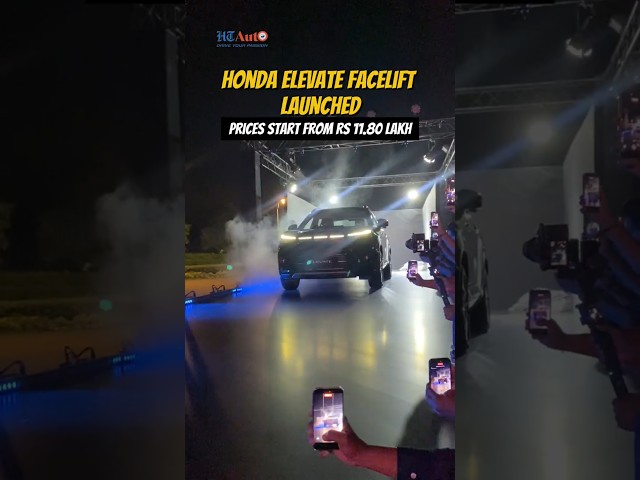
Let's start with the obvious changes. The Elevate facelift looks familiar because, well, it is still the same SUV underneath. Honda hasn't attempted to change its overall proportions or silhouette, and that makes sense for a mid-life update.
The front end gets most of the attention. The grille gets a redesigned treatment with a thicker horizontal element, while the Honda logo moves from the grille to the bonnet. Some chrome detailing has also been replaced by black trim, and the fog lamp surrounds are now finished in the body colour.
Personally, I prefer the older grille. The new design looks a little too heavy for my liking, although the rest of the SUV retains its familiar, upright stance. Along the sides, the chrome window-line trim and door handles have been replaced by black and body-coloured elements, respectively. The 17-inch alloy wheels get a revised design, while the top-spec version now gets rear disc brakes.
At the rear, the biggest change is the illuminated connecting element between the tail-lamps. It gives the SUV a more contemporary appearance without altering its overall design.
The interior changes are subtle but useful. The dashboard gets revised detailing, ambient lighting and new ivory upholstery, replacing the earlier tan finish. The lighter cabin feels airier, although keeping it clean could require some effort.
More importantly, Honda has added a 360-degree camera, power adjustment for both front seats, wireless charging and an electronic parking brake with auto-hold. The last of these is particularly welcome, replacing the manual handbrake that felt a little dated.
The 10.25-inch touchscreen and partly digital instrument cluster carry over. The screen is responsive, but its interface looks increasingly dated against newer rivals. Thankfully, Honda retains physical climate-control buttons, making everyday operation easier.
Space has always been one of the Elevate's strengths, and that hasn't changed. With the front seat adjusted to my driving position, there's plenty of knee room and headroom in the second row. The seats offer good under-thigh support, making the cabin comfortable for longer journeys.
The big addition is rear seat ventilation, a segment-first feature according to Honda. Considering how hot Indian summers can get, this is arguably one of the most useful additions to the facelift. Rear AC vents and Type-C charging ports are present, too.
The 458-litre boot remains unchanged and is practical enough for everyday luggage and weekend trips. The loading lip is slightly high, but the 60:40 split rear seats offer additional flexibility when carrying longer items.
Under the bonnet, the Elevate continues with a 1.5-litre naturally aspirated petrol engine producing 121 hp and 145 Nm. Transmission options include a six-speed manual and a CVT automatic, which was the version I drove.
This isn't an engine that delivers a sudden surge of acceleration, but it has a charm of its own. It's smooth and refined during everyday driving, and the CVT responds quickly when you need to pick up speed.
Push harder, and the familiar rubber-band effect becomes noticeable as the engine revs rise before the car gathers speed. However, Honda has kept this characteristic reasonably well controlled. The engine also develops a pleasant, raspy note when worked hard, making it more enjoyable than its specifications might suggest.
Would a turbo-petrol engine make the Elevate quicker? Certainly. But there's something satisfying about the progressive response of this naturally aspirated unit, particularly if you enjoy working an engine rather than relying on a sudden burst of low-end torque.
The Elevate's biggest appeal, at least from an enthusiast's perspective, lies in how it drives. Despite its tall stance, it feels composed through corners, with direct steering that inspires confidence without becoming tiring in traffic.
The suspension strikes a good balance between comfort and control. It absorbs most everyday bumps neatly, although larger potholes and harsher undulations can make themselves felt inside the cabin.
The brakes are responsive and predictable, while the elevated seating position and good forward visibility make the SUV easy to place on the road.
It isn't a performance SUV, nor does it pretend to be one. But the chassis feels well sorted, and the way the steering, suspension and brakes work together makes the Elevate enjoyable to drive. That matters, especially when so much of the segment's attention is focused on screens and equipment lists.
Honda says it has worked on the Elevate's noise, vibration and harshness levels. Engine noise is reasonably well contained, particularly in stop-and-go traffic. However, tyre noise becomes quite noticeable at highway speeds.
During our drive on the Mumbai-Delhi Expressway, road noise was evident at triple-digit speeds, although wind noise remained relatively subdued. The SUV uses MRF Wanderer tyres, but without testing it on a different set, it's difficult to say how much of the noise comes down to the tyres themselves.
The Elevate remains a capable highway companion, but better control over road noise would have made long-distance driving more relaxing.
The 2026 Honda Elevate facelift doesn't reinvent the SUV, but it makes some meaningful improvements. The 360-degree camera, power-adjustable seats, electronic parking brake and rear seat ventilation address a few of the gaps in the earlier package.
Its biggest strengths, however, remain unchanged. The petrol engine is smooth, the CVT is responsive for its type, the cabin is spacious and the chassis offers a level of driver engagement that isn't always a priority in this segment.
There are still shortcomings, including the dated infotainment interface and noticeable tyre noise at highway speeds. And with rivals offering increasingly varied powertrain options, the absence of a hybrid version remains an obvious question mark.
For those who value a comfortable, practical SUV that's also pleasant to drive, the Elevate deserves a closer look. But in a segment where standing still can mean falling behind, the question is whether these updates will be enough to keep buyers interested.
Personally, I'd be more intrigued by a hybrid Elevate. The existing package has plenty going for it, and electrification could add another dimension to its appeal. For now, though, the facelift leaves us with a familiar Honda proposition: one that prioritises the fundamentals, even if it doesn't always chase the latest trends.
Honda Elevate is available in the 7 Colours in India.
View all Popular Suv Cars
| Rear AC Vents | Yes |
| Max Power | 119 bhp |
| Body Type | SUV |
| Airbags | 6 Airbags |
| Max Torque | 145 Nm |
| Keyless Entry | Yes |
| Mileage | 16.61 kmpl |
| Transmission | Manual,Automatic |
| Engine | 1498 cc |
| Fuel Type | Petrol |
| Sunroof | Single Pane |
Honda Elevate in India is available in Petrol variants. Average mileage of Honda Elevate's petrol variant is 15.31 kmpl (As claimed by the brand in ideal road conditions). Honda Elevate SV Petrol 1.5L Manual comes with a 40 litres fuel tank.
Popular Honda Cars