
MG Hector Tomahawk EV Key Specs
- 517 km
Range - 0.6 hrs
Charging - 69.2 kWh
Battery Capacity - 579 litres
Boot Space - 150 kW
Motor Power

Based on your credit profile


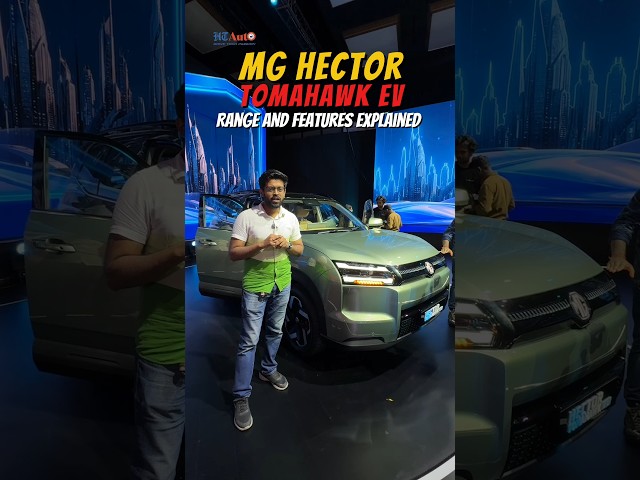
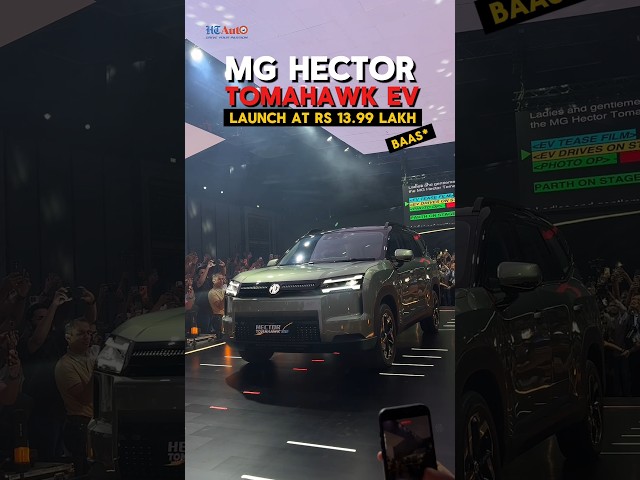
MG Motor India launched the Hector Tomahawk EV, offering three variants with the Exclusive trim being most value-for-money.Read Full Story
The MG Hector Tomahawk EV offers a spacious, comfortable electric SUV experience with modern features, prioritizing practicality and ease of use.Read Full Story
MG Motor India launched the Hector Tomahawk EV and PHEV, competing with Tata Harrier EV in India's electric SUV market.Read Full Story
MG Motor India launched the Hector Tomahawk EV, a three-row electric SUV, competing with Mahindra XEV 9S.Read Full Story
Electric SUVs are getting bigger, faster and increasingly loaded with technology. But when you get behind the wheel of something like the Hector Tomahawk EV, the question isn't really about how quickly it can accelerate or how many screens it packs. It's about whether it can deliver the kind of relaxed, comfortable experience you'd expect from a large family SUV, while making the switch to electric feel easy.
Priced from ₹19 lakh (ex-showroom), the Tomahawk EV enters a segment where buyers have plenty of options, including some well-established SUVs with conventional powertrains. MG's answer is a five-seater with a spacious cabin, a claimed range of 517 km and enough features to keep even the most tech-hungry buyers occupied.
We drove it in Kochi to find out what the Tomahawk EV is like when you move beyond the specifications sheet. Is it genuinely enjoyable to drive? How well does it handle India's broken roads? And can it deliver the kind of comfort and practicality that makes a large SUV worth considering?
The MG Hector Tomahawk EV has a rather flamboyant name, but the SUV itself is surprisingly understated. And honestly, I think that's a good thing. At 4,700 mm long, this is a sizeable SUV, but MG has managed to get the proportions right. It looks substantial without appearing unnecessarily bulky, and the overall design has a sense of balance that works well for its size.
Despite being an electric vehicle, MG hasn't gone down the route of making the Tomahawk look like a spaceship. Instead, it gets a fairly traditional SUV design, with sleek headlamps, a clean front end and a slab-sided profile that gives it a solid stance. The chunky plastic cladding adds some visual toughness, while the rear is neatly finished without too many unnecessary styling elements.
The result is an SUV that looks modern but doesn't scream for attention. The Tomahawk name might suggest something far more dramatic, but the design is actually quite mature. It has enough road presence to make you notice it, without trying too hard to stand out in a crowded parking lot.
The first thing you'll notice when you step into the Tomahawk EV is how familiar the cabin feels if you've spent time in the MG Windsor EV. The overall approach is similar, with a minimalist dashboard that keeps things looking clean and uncluttered. However, the Tomahawk gets its own layered dashboard design, and that gives the cabin a distinct identity.
The upper and lower sections of the dashboard are finished in hard plastic. They aren't particularly plush, but they feel good to the touch and don't come across as cheap. The middle section gets soft-touch material, which is also used on the upper portion of the door pads and the armrests.
There are silver accents around the air vents, door handles and the central dashboard section. These add a bit of contrast to the otherwise simple interior. Overall, the cabin feels well put together. During our drive, we spent time on some rough and cobbled sections of road, and I didn't hear any squeaks or rattles coming from the dashboard or door panels.
My only concern is the tan leather upholstery. It looks good and certainly adds a premium touch to the cabin. But if you're someone who uses their SUV regularly, especially with family, keeping this lighter shade clean could require some effort.
If you enjoy having plenty of technology in your car, the Tomahawk EV won't leave you wanting much. The SUV gets an 8.8-inch digital instrument cluster as standard across the range. The top-spec Essence variant takes things further with a massive 15.6-inch touchscreen infotainment system, which comes with wireless Android Auto and Apple CarPlay.
You also get:
10-speaker Infinity sound system.
Ambient lighting.
AI-powered voice assistant.
Karaoke function.
PM2.5 cabin air filter.
Some features, such as the karaoke function, may not be high on everyone's priority list. But that's the point with a vehicle like this. MG is clearly trying to offer a cabin that feels feature-rich, and it has succeeded in that regard.
The Tomahawk EV isn't just about looking modern and offering a long list of features. Spend some time inside the cabin, and you'll notice that MG has put thought into the smaller details that make a car easier to live with.
The door pockets are large enough to accommodate big bottles, while the central tunnel offers plenty of space for smaller belongings. There's a dedicated slot for your smartphone, and if you have a compatible device, you can use the wireless charging pad.
There's also a small cubby for your keys, along with space for a wallet or loose change. The centre armrest hides a reasonably sized storage compartment, and if you somehow manage to fill all of that, there's another storage area underneath the centre tunnel. None of these storage solutions is particularly revolutionary. But when you put them all together, they make the cabin feel thoughtfully designed.
The Tomahawk EV is a large SUV, and it makes good use of that size. With the driver's seat adjusted to my driving position, at 5 feet 8 inches tall, I had plenty of knee room in the second row. Headroom was also quite decent, despite the panoramic sunroof fitted to the test vehicle. Under-thigh support is good, too, which should help keep passengers comfortable on longer journeys.
The rear bench is wide enough to accommodate three adults, and the flat floor is a welcome addition. There's no large transmission tunnel getting in the way of the middle passenger's feet, so sitting three across should be fairly comfortable.
MG has also paid attention to rear-seat equipment. You get three headrests, a thickly padded centre armrest with two cupholders, seat-back pockets behind both front seats and dedicated AC vents. There are USB Type-A and Type-C charging ports, along with a space to keep your phone while it's charging. The door pads get soft-touch material, and the rear doors also feature sunblinds.
The Tomahawk EV gets a powered tailgate, although there is no gesture control. So, if you arrive at the car with both hands full of luggage, you'll still need to put something down before opening the boot. It's a small omission, but one that would have been nice to have on a vehicle positioned as a feature-rich family SUV.
Once open, the five-seater version offers 610 litres of boot space. That's a healthy amount of room, and the boot itself is shaped well. You can easily fit a couple of large suitcases, along with smaller bags, without having to play a game of luggage Tetris. There's no significant loading lip either, which means pushing heavier bags inside is relatively easy.
Need more room? Fold down the second-row seats and the available storage capacity increases to over 1,000 litres. The good part is that the folded seats don't leave a significant hump in the extended loading area. This makes it easier to push longer items further into the cabin. For a family that regularly travels with luggage, the Tomahawk EV should be more than capable of handling the job.
Now, let's talk about the part that usually interests me the most: what's it like behind the wheel? The MG Hector Tomahawk EV gets a single electric motor producing approximately 200 bhp and 310 Nm of torque. There are four driving modes on offer: Eco, Normal, Sport and Custom, along with four levels of regenerative braking. On paper, those numbers are respectable for a large family SUV. But the more important question is how that power is delivered.
The short answer? Quite well. No matter which drive mode you choose, the Tomahawk EV pulls away cleanly. Sport mode gives you access to the full potential of the electric motor, but even Eco and Normal modes don't feel particularly dull. The throttle response is quick, and the initial acceleration can get quite addictive. There's enough shove to make overtaking feel effortless, and you don't have to plan every move well in advance.
But what I particularly liked was how manageable that performance felt in traffic. You can modulate the accelerator easily, and despite the quick acceleration, it never feels jerky during stop-and-go traffic. That makes it a very easy SUV to drive around town. It's quick when you want it to be, but it doesn't constantly remind you that it has a powerful electric motor underneath.
The Tomahawk EV gets four levels of regenerative braking, and selecting the most aggressive setting brings you fairly close to a one-pedal driving experience. However, it doesn't quite go all the way. Even in the strongest regen mode, the SUV slows down to a crawl rather than coming to a complete stop. You'll need to use the regular brakes for the final few metres. It's not a major issue, and you get used to it fairly quickly. But if you've driven an EV that comes to a complete halt using only regenerative braking, you'll notice the difference.
The Tomahawk EV comes with a 69.2 kWh battery pack, which promises a claimed range of 517 km on a full charge. That's a useful figure for a large SUV, particularly if you intend to use it for highway trips. But as always, the real-world range will depend on how and where you drive. During our drive, the SUV started with 99 per cent battery charge and displayed an estimated range of 486 km.
After covering 120 km, the battery level had dropped to 74 per cent, while the displayed range stood at 362 km. Now, before you start calculating the exact efficiency from these numbers, remember that this wasn't a controlled range test. Traffic, road conditions, driving speeds and air-conditioning usage all influence the result.
Now, if there's one area where I think MG has genuinely nailed the Tomahawk EV, it's the ride quality. We drove this SUV over smooth tarmac, broken roads and even cobbled sections, and the suspension handled all of them with impressive composure. The bumps are absorbed really well, and very little of the impact makes its way into the cabin. You can hear the suspension working over some of the rougher surfaces, but you don't necessarily feel those jolts inside. In fact, the ride quality is good enough that I can see this being a very appealing road-trip vehicle.
Of course, the comfortable suspension setup does come with a trade-off. The Tomahawk EV isn't the kind of SUV you'll want to throw into corners just for fun. The suspension has clearly been set up to keep passengers comfortable, and you can feel that in the way it leans through bends.
But here's the thing: it never feels sloppy or floaty. The suspension settles down quickly, and unless you're driving like you're late for a track day, there's very little to complain about. If your idea of a good drive involves a relaxed highway run rather than attacking every corner, the Tomahawk EV's priorities will make perfect sense.
The brakes are another aspect of the Tomahawk EV that I liked. They have a progressive feel, which makes it easy to bring the SUV to a smooth stop during regular driving. At the same time, there's enough bite available when you need to slow down quickly.
The MG Hector Tomahawk EV isn't trying to reinvent the electric SUV. Instead, it takes a fairly straightforward approach: offer a large, comfortable and well-equipped SUV, and make the transition to electric power as easy as possible. And after spending time with it, I think that approach works.
The Tomahawk EV is spacious enough for a family, has a useful boot, offers plenty of features and delivers the kind of ride quality that makes Indian roads considerably less frustrating. The electric motor is quick, but the SUV remains easy to drive smoothly in traffic.
It isn't particularly sporty, and the suspension does lean when you push it through corners. The tan upholstery may also need more attention than darker interiors, while the regenerative braking system doesn't quite offer full one-pedal driving. But none of these characteristics undermines what the Tomahawk is fundamentally trying to achieve.
This is an SUV that prioritises comfort and convenience, and it does those things well. The other interesting aspect is the pricing. The base seven-seater variant starts at ₹19.50 lakh (ex-showroom), but MG's Battery as a Service programme can bring the effective price of the top-spec five-seater Essence variant down to ₹14 lakh.
That's a substantial difference in upfront cost, although you will need to consider the ongoing battery subscription expenses before deciding whether the BaaS route makes sense for you. Ultimately, if you're looking for a spacious electric SUV that can handle daily commutes, family duties and the occasional road trip without making you work too hard, the MG Hector Tomahawk EV deserves a look.
| 1 & above | |
| 2 & above | |
| 3 & above | |
| 4 & above | |
| 5 rating |
| Max Power | 201 bhp |
| Rear AC Vents | Yes |
| Body Type | SUV |
| Airbags | 6 Airbags |
| Battery Capacity | 69.2 kWh |
| Max Torque | 310 Nm |
| Transmission | Automatic |
| Range | 517 km |
| Max Motor Performance | 150 kW / 310 Nm |
| Charging Time | 35 Minutes |
| Sunroof | Yes |
Popular MG Cars
Copyright © HT Media Limited All rights reserved.