Gadkari says EV–ICE parity is months away. The Math says otherwise

Union Transport Minister Nitin Gadkari recently made waves within the industry with an ambitious forecast: in the next four to six months, EVs in India may be as affordable as petrol vehicles.
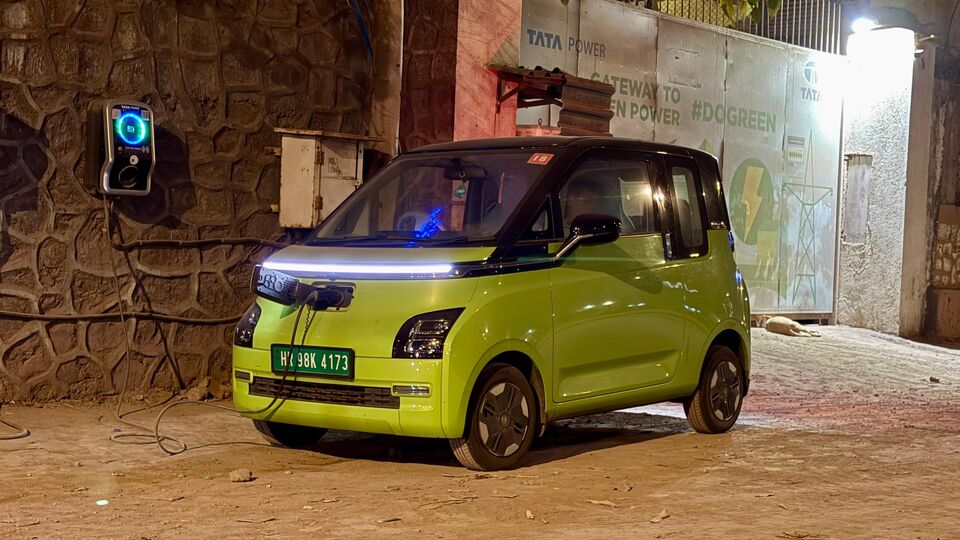


For over a century, the history of cars in India has been that of the rumble of the internal combustion engine. Diesel and petrol have powered cars, livelihoods, supply chains, and dreams. Today, the soft purr of the electric motor is re-writing that narrative, gradually, but with unmistakable purpose.


So when Union Minister Nitin Gadkari recently declared that electric vehicles (EVs) could soon cost the same as petrol cars, perhaps within four to six months, it was bound to turn heads. The sentiment is noble; the math, however, is far more complicated. For a country spending nearly ₹22 lakh crore every year on importing fossil fuels, the ambition of rapid EV affordability is both timely and tempting. But in the cold arithmetic of cost, technology, and localisation, parity is still some distance away.
Also check these Vehicles

Also Read : EVs to cost the same as petrol cars within 4 to 6 months, promises Nitin Gadkari
GST cuts: The unintended curveball
India recently announced the GST 2.0 policy which has led to the reduction of prices of almost every single item in the country. Ironically, this well-intentioned tax reform has ended up complicating the EV affordability narrative. The government’s recent decision to reduce GST on ICE vehicles from 28 per cent to 18 per cent was framed as a move to boost automotive demand amid a patchy market recovery. For the industry, it brought some respite, especially for entry-level and mid-size petrol cars that have been facing pressure from increasing input costs and sagging rural demand.
But this apparently innocuous policy change has been in some ways not-so-benign for the EV ecosystem. While electric vehicles continue to enjoy a concessional 5 per cent GST rate, the relative reduction for petrol and diesel cars has effectively widened the affordability gap, not narrowed it.
Take the entry-level segment, the ₹6–10 lakh bracket that forms the heart of India’s car market. Before the GST revision, a petrol hatchback and its electric equivalent (if available) were separated by roughly ₹2–3 lakh. The 10 per cent tax cut on ICE models trims that difference further, making the EV’s price premium even harder to justify for the cost-conscious buyer.
It is expected that such policy asymmetry makes short-term parity almost impossible, especially when battery and cell costs remain globally indexed. While the 5 per cent GST on EVs is unlikely to be lowered further, the reduction on ICE vehicles has brought them temporarily closer to their best affordability phase, ironically, just when EV makers were hoping to bridge the gap through scale.
The battery bind
The real battle for parity, however, is being fought inside the battery pack. It remains the single most expensive component of an EV and the biggest reason prices refuse to fall fast enough.
Also Read : Check out 5 electric vehicles that are about to launch in India soon
India still imports its battery cells, leaving manufacturers exposed to volatile global raw material prices. Despite advances in energy density and falling international cell costs, the so-called “battery premium" persists, especially in passenger cars priced below ₹10 lakh.
This is why parity in the next few months remains a stretch. Electric scooters and premium EVs might bridge the gap at either end of the market, but for the mid-tier, volume-driven segment, the numbers simply don’t add up yet.
Lessons from abroad
China provides the most instructive example. Decades of investment in localised battery manufacturing, component ecosystems, and aggressive price competition have made its EVs not just affordable but aspirational. Europe and the U.S., by contrast, are still dealing with an EV price premium of around 20 per cent, despite subsidies.
India sits somewhere in between, with a thriving domestic market but a heavy reliance on imports. Until supply chains are localised and cell production scales up, the dream of true parity will remain just that, a dream in progress.
Where the near-term opportunity lies
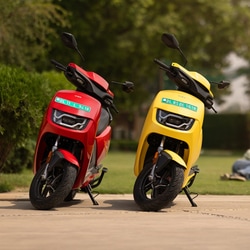
If there’s one bright spot, it’s the two-wheeler segment, where total cost of ownership (TCO) parity has already arrived for urban commuters and delivery fleets. Lower running costs, simpler charging needs, and short-distance use cases make electric two-wheelers a practical alternative.
At the other end, premium electric cars have managed to absorb higher costs through margins and branding. But in the middle, where the Indian car market truly lives, parity will need years of patient localisation, scale, and cost innovation.
The pragmatic path forward
To his credit, Gadkari’s optimism is not misplaced. It signals intent, an urgency to accelerate India’s transition to cleaner mobility. The multi-pathway strategy of the government, ranging from biofuels and flex-fuel technology to ethanol and EVs, indicates a wide-strategic thinking.
Yet, the industry knows that EV affordability is not a policy decree, it’s an ecosystem outcome. Scaling domestic cell production, deepening component localisation, rationalising logistics, and strengthening the charging network are what will make EVs truly accessible to the mass market.
Bottom line
Electric mobility is not a question of if, but when and how. The road to price parity between ICE and EVs will not be won in months but over years of sustained industrial alignment.
EVs will continue to grow; their momentum is irreversible. But to expect full price parity across India’s mass-market passenger car segment in a few months is to mistake direction for destination. The transition will be uneven, affordable for some, aspirational for others, and full of opportunity for those who can marry technology with execution.
Get insights into Upcoming Cars In India, Electric Vehicles, Upcoming Bikes in India and cutting-edge technology transforming the automotive landscape.

Editor's Pick



Trending this Week