Isuzu V-Cross vs Toyota Hilux specification comparison: price, engine, features, safety

India’s pick-up market is growing, led by the Isuzu V-Cross and Toyota Hilux. The Hilux offers superior power and torque, whereas the feature-rich V-Cross provides a more affordable alternative.
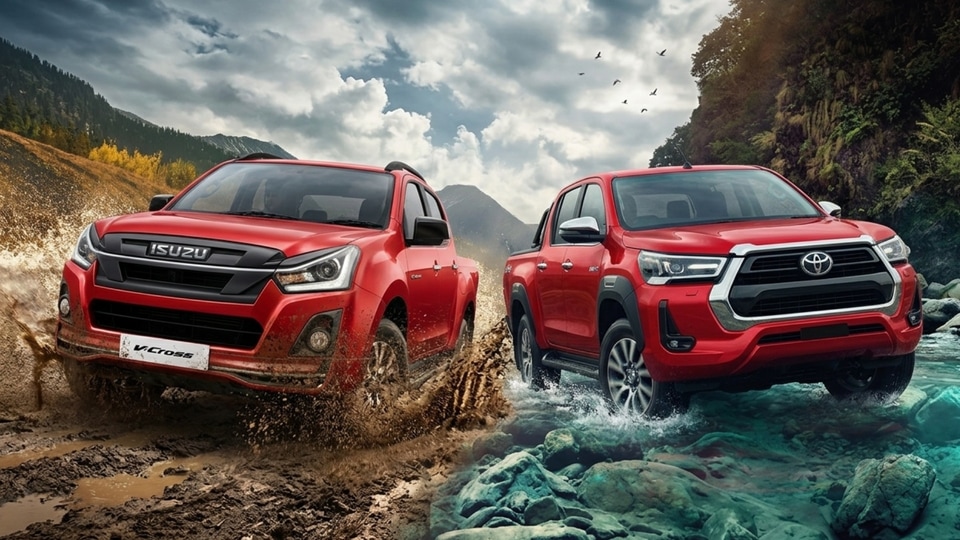


Pick-up vehicles are slowly becoming popular in India post the launch of Tata Xenon, Toyota Hilux and Isuzu V-Cross in the Indian market. While the Tata Xenon has been discontinued in India, the Toyota Hilux and Isuzu V-Cross have gone from strength to strength in the market. However, how would the two Japanese pick-up vehicles fare against each other? Let’s find out:






Isuzu V-Cross vs Toyota Hilux: Engine
The Isuzu V-Cross is powered by a 1.9L four-cylinder turbocharged diesel engine producing 160.9 bhp and 360 Nm of peak torque, paired with a six-speed manual or a six-speed automatic transmission. In addition to that, the V-Cross boasts a shift-on-fly four-wheel drive system, allowing the pick-up vehicle to conquer even the harshest of terrains. The Isuzu V-Cross is widely regarded as extremely reliable and capable of driving through bad patches of road without breaking a sweat.
Also check these Cars
The Toyota Hilux is powered by a 2.8L four-cylinder turbocharged diesel engine producing 201.1 bhp and up to 500 Nm of peak torque, paired with a six-speed manual or six-speed automatic transmission. Additionally, the Toyota Hilux gets a four-wheel drive with four low and four high settings for off-road travel. The Toyota Hilux has been regarded as one of the most reliable cars in the world, capable of handling any kind of punishment.
Isuzu V-Cross vs Toyota Hilux: Features
The Isuzu V-Cross is equipped with features, including a 10.13-inch touchscreen digital infotainment system with wireless Apple CarPlay and Android Auto, a 360-degree camera, an 8-speaker audio system, an idle start-stop system, a six-way electrically adjustable driver seat, steering-mounted controls, automatic climate control, auto up/down power windows, foldable rear seats with 60:40 split and electrically adjustable and foldable ORVMs with integrated turn indicators, among other features.
The Toyota Hilux, on the other hand, boasts of a feature list, including soft leather upholstery, heat rejection glass, an 8-inch touchscreen digital infotainment system with Android Auto and Apple CarPlay, electrochromic IRVM, a TFT multi-information display, a six-speaker audio system, dual glovebox layout with cooled upper compartment, multiple drive modes, foldable rear seats with 60:40 split, parking sensors in the front and rear, and power steering with variable flow control, among other features.
Also Read : Petrol, diesel prices hiked for the second time in a week, up about 90 paise a litre
Isuzu V-Cross vs Toyota Hilux: Safety
The Isuzu V-Cross boasts a host of safety features, including a tyre pressure monitoring system, a blind spot monitoring camera system with turn-indicator operation, a traction control system, an electric stability control, hill descent control, hill start assist, emergency brake assist, brake override system, side anti-intrusion bars, transfercase protector, steel underbody protection, six airbags, and traction control system, among others.
The Toyota Hilux, on the other hand, gets a suite of safety and security features, including vehicle stability control with brake assist, hill assist control, anti-lock braking system, an emergency brake signal and seven airbags, among others.
Isuzu V-Cross vs Toyota Hilux: Price
The Isuzu V-Cross has a starting ex-showroom price of ₹25.50 lakh, while the Toyota Hilux is priced slightly higher than that at ₹28.52 lakh (ex-showroom).
Check out Upcoming Cars in India 2026, Best SUVs in India.


Editor's Pick



Trending this Week