Audi Q9 debuts first-of-its-kind curved digital OLED taillights
Audi’s upcoming Q9 will debut curved digital OLED tail-lights, featuring 512 controllable segments, eight lighting signatures and advanced safety functions, marking the third generation of Audi’s OLED technology.
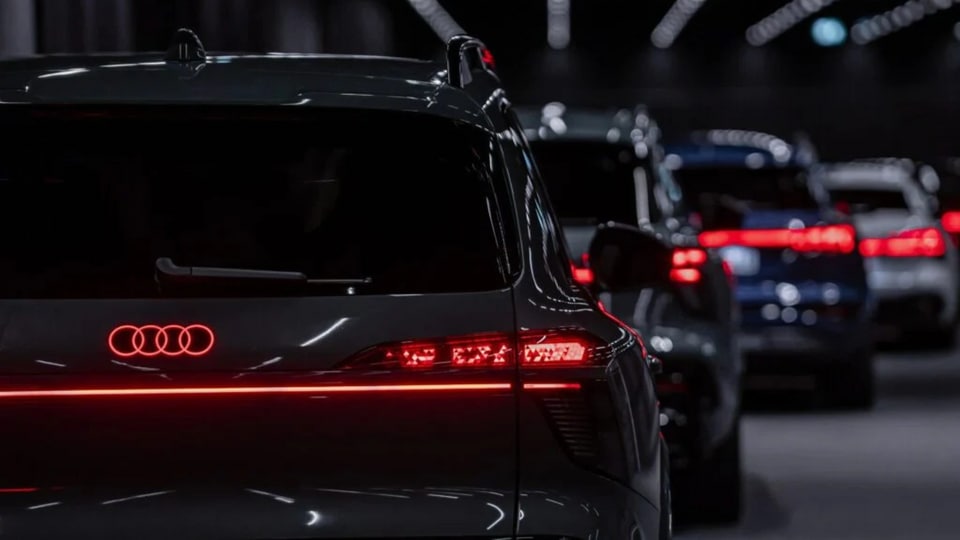


German luxury automaker Audi has announced that its upcoming flagship SUV, the Q9, will become the first production car to feature three-dimensionally curved digital OLED rear-light panels. The technology uses carrier glass measuring just 0.1 mm thick, approximately the thickness of a human hair, allowing the panels to bend to a radius of 200 mm and follow the vehicle’s body contours.
“At Audi, light means safety first and foremost—seeing and being seen. Digitalisation opens up entirely new possibilities for further enhancing road safety. The curved digital OLED technology in the Audi Q91 impressively demonstrates this technology’s potential. It combines design freedom, personalisation, and communication with the vehicle’s surroundings at a new level. Our vision is to gradually transform light into an intelligent means of communication that makes interaction between the vehicle and its surroundings even safer and more intuitive."
Also check these Cars

Audi’s Third-Gen OLED Technology
The third generation of Audi’s digital OLED technology features 512 individually controlled segments distributed across six panels, with the largest panel comprising 99 segments. The system offers up to eight selectable light signatures at both the front and rear, including new semi-active designs that incorporate three-dimensional lighting effects.
At the front, the Q9’s digital Matrix LED headlights use a micro-LED module measuring approximately 13 mm wide. It contains 25,600 micro-LEDs, each around 40 micrometres in size. The headlights can project lane and orientation lighting onto the road, along with turn signals designed to be visible to pedestrians and cyclists before the vehicle changes direction.
Also Read : Ferrari CEO praises Tesla Roadster, singles out upside-down stunt
Audi OLED Rear Lights: History
The journey with OLED rear light technology of the ‘House of Four Rings’ began with the TT RS in 2016. The automaker became the first in the world to introduce organic light-emitting diodes (OLEDs) as a production rear-light technology, opening up new possibilities for automotive lighting design. The technology offered uniformly illuminated surfaces, high contrast and dynamic lighting effects.
In 2020, Audi took the next step with the Q5, introducing digital OLED technology that allowed individual lighting segments to be controlled independently, enabling customers to select different rear light signatures and personalise the lighting design of their vehicles. Furthermore, the technology advanced in 2024 with the second generation of digital OLEDs in the Audi Q6 e-tron. The number of individually controllable segments increased tenfold, accompanied by new safety-oriented features. Its communication light system introduced warning symbols to alert other road users to potential hazards, including breakdowns, emergency braking and accident scenes. The model also featured a proximity warning function, first introduced on the Q5, which activates all digital OLED segments to make a stationary vehicle more noticeable when other road users approach.
A decade after its first production application, Audi’s OLED technology has reached its third generation with the Q9. Combining distinctive lighting design with advanced safety and communication functions, the latest iteration aims to enhance the vehicle’s identity while making interactions with surrounding road users more effective. The Q9 represents another milestone in Audi’s ongoing development of automotive lighting technology.
Check out Upcoming Cars in India 2026, Best SUVs in India.
Editor's Pick




Trending this Week